Section 5
The lifecycle
Do it in the browser Explore the lifecycle
Remember
- A detection leaves a stage only when its definition of done is met, and every definition of done is a count someone can check.
- Research ends with field names read from a real event and a 7-day count of how often the behavior happens normally.
- Deploy with alerting off, and switch alerting on only after 7 days at or under the alert volume threshold.
- Every tuning change is a pull request that goes back through validate.
- A retired detection keeps its record and gets a retirement note. Any replacement starts at intake with a link to that note.
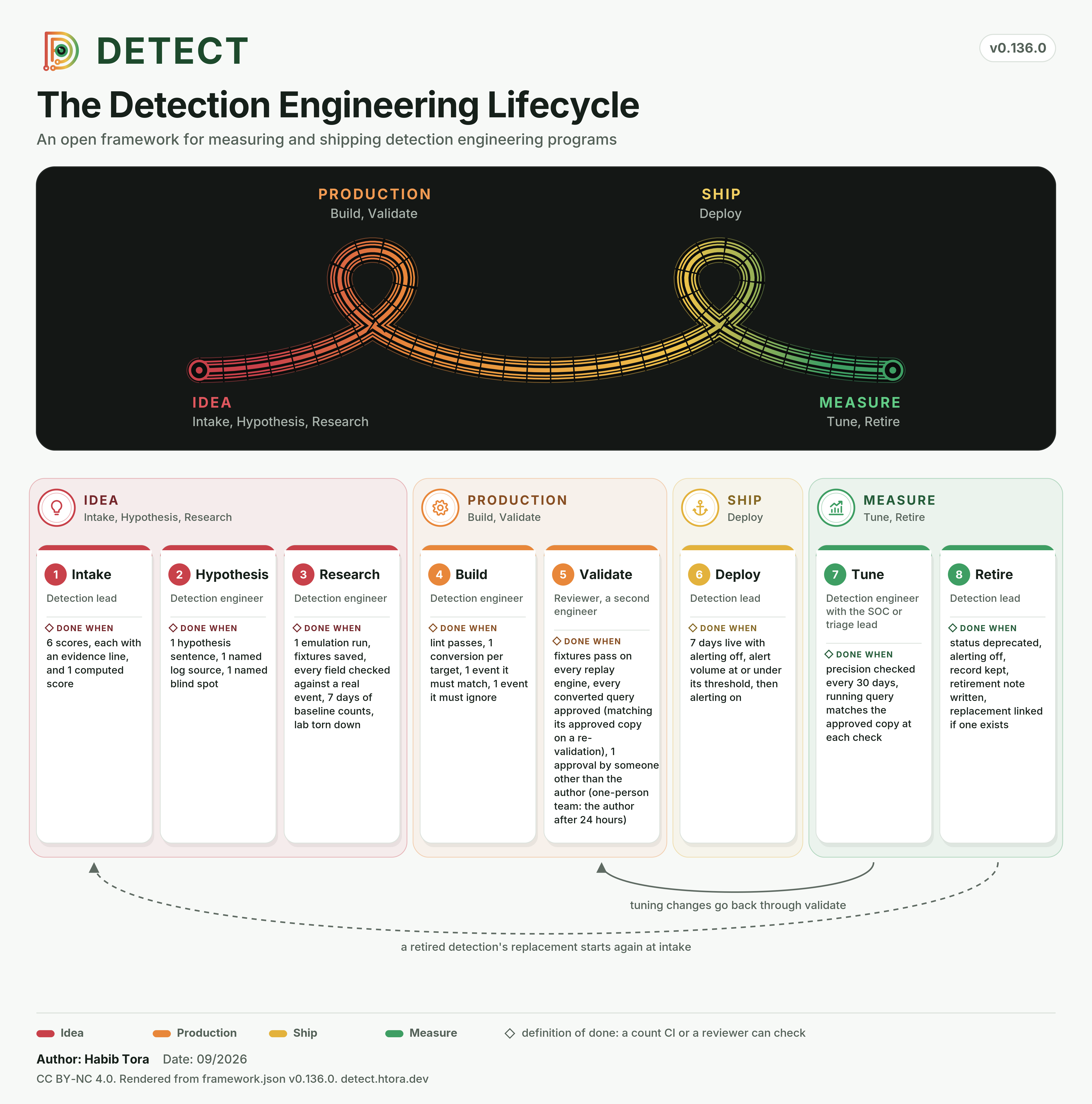
I grouped the stages onto three lines. The Backlog line carries intake, hypothesis, and research; the Build line carries build and validate; the Live line carries deploy, tune, and retire. A tuning change loops back to validate as a pull request. The replay runs the changed rule against its fixtures, so an exclusion that blinds it to the attack fails the build. A retired detection's replacement loops back to intake with a link to the retirement note, so the next hypothesis starts from why the old one was pulled.
| Stage | What it is for | Definition of done, counted | Owner | Metrics |
|---|---|---|---|---|
| 1. Intake | Write down a request for a new detection with enough context that it can be scored. | 6 scores, each with an evidence line, and 1 computed score | Detection lead | intake_to_score_days, backlog_age_days |
| 2. Hypothesis | Write one sentence saying what the detection will catch, which log source it needs, and what it will miss. | 1 hypothesis sentence, 1 named log source, 1 named blind spot | Detection engineer | readiness_at_hypothesis |
| 3. Research | Produce the events the rule will be written against, and confirm they exist in your logs. Then count how often they appear during normal business. | 1 emulation run, fixtures saved, every field checked against a real event, 7 days of baseline counts, lab torn down | Detection engineer | research_hours_per_rule |
| 4. Build | Write the detection in Sigma and the tests that prove it. | lint passes, 1 conversion per target, 1 event it must match, 1 event it must ignore | Detection engineer | percent_with_tests |
| 5. Validate | Prove the detection fires on what it should catch, stays silent on what it should ignore, and still matches the query a reviewer approved. | fixtures pass on every replay engine, every converted query approved (matching its approved copy on a re-validation), 1 approval by someone other than the author (one-person team: the author after 24 hours) | Reviewer, a second engineer | first_pass_validation_rate, review_turnaround_hours |
| 6. Deploy | Put the detection into production with alerting switched off, leave it running for 7 days, and switch alerting on only if the alert count stayed at or under its threshold. | 7 days live with alerting off, alert volume at or under its threshold, then alerting on | Detection lead | deploy_lead_time_days, post_deploy_replay_failures, detection_latency_median |
| 7. Tune | Keep the share of true alerts above the agreed floor as the environment changes. | precision checked every 30 days, running query matches the approved copy at each check | Detection engineer with the SOC or triage lead | precision_30d, triage_minutes_median, minutes_per_true_positive, upkeep_minutes_per_detection |
| 8. Retire | Remove detections whose alerts cost more analyst time than they are worth. | status deprecated, alerting off, record kept, retirement note written, replacement linked if one exists | Detection lead | rules_retired_per_quarter, rule_debt |
The metrics column leaves out the 15 metrics that measure the program as a whole: robustness_weighted_coverage, incident_detection_rate, silent_source_hours, priority_technique_gaps, misses_by_cause, open_detection_fixes_age, false_close_rate, time_to_scope_hours, time_to_contain_minutes, notifications_on_time, playbook_coverage, playbook_minutes_saved_per_alert, playbook_actions_unattended, playbook_actions_reverted, and incidents_without_followup.
Appendix A has the full definition of done wording, the mistake that usually stalls each stage, and where a detection goes when a stage's count can't be met.